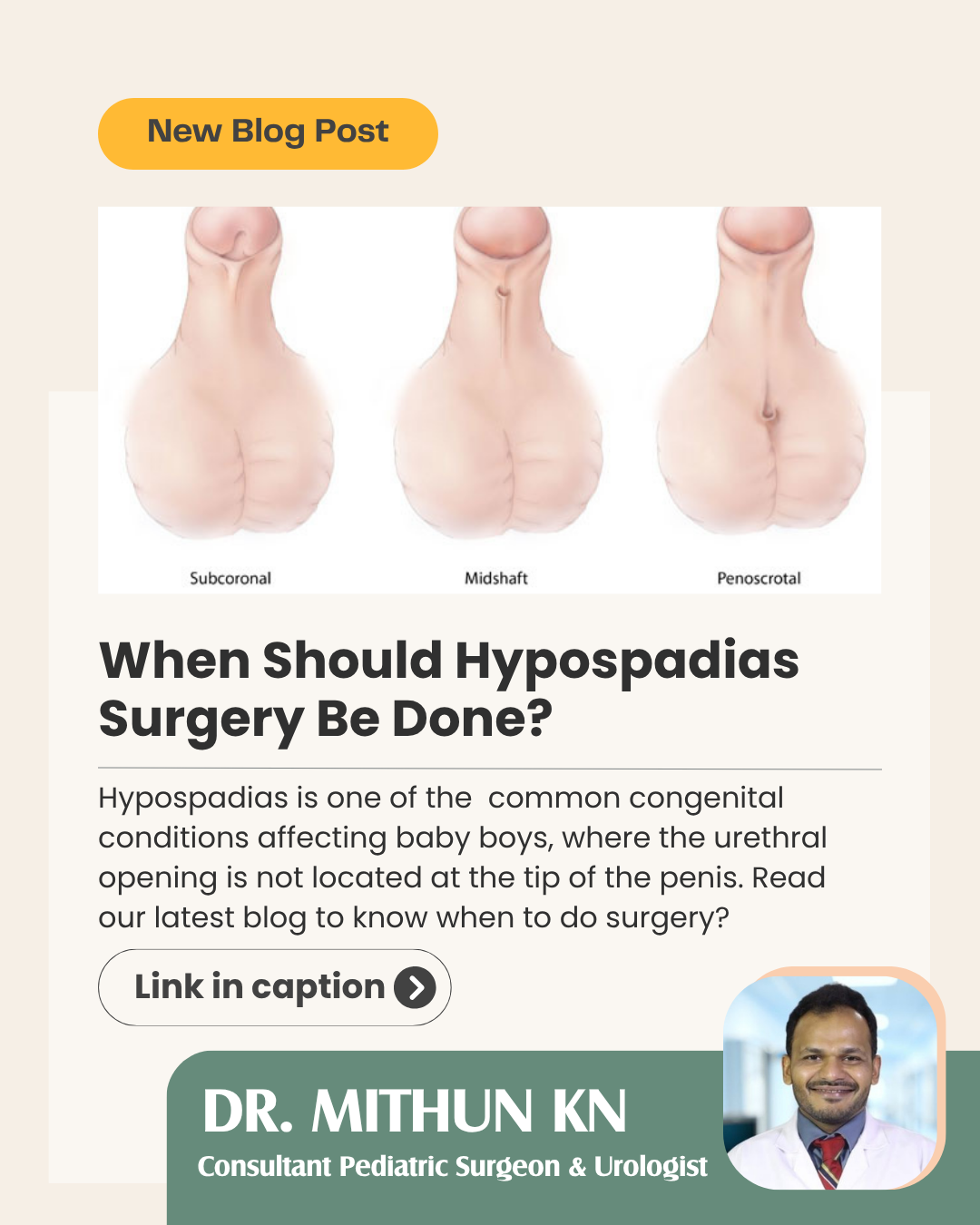
Hypospadias is a birth defect in boys where:
- The urinary opening is located below the tip of the penis
- The foreskin may appear incomplete or hooded
- The penis may show downward curvature (chordee)
- Urine stream may be abnormal
Normally, the urethral opening is present at the tip of the penis. In hypospadias, this opening develops at an abnormal location during fetal growth.
Hypospadias is usually detected at birth during newborn examination.
The symptoms vary depending on the severity and type of hypospadias.
Common Signs Include:
- Urine opening located below the penis tip
- Curved penis during erection (chordee)
- Hooded foreskin appearance
- Abnormal urine spraying
- Difficulty passing urine standing up
- Cosmetic concerns
- In severe cases, fertility issues later in life
Parents often notice that the baby’s urine stream points downward or sprays abnormally.
Types of Hypospadias
The condition is classified based on where the urethral opening is located.
- Distal Hypospadias
This is the mildest and most common type.
The opening is near the head of the penis.
Includes:
- Glanular hypospadias
- Coronal hypospadias
- Subcoronal hypospadias
- Midshaft Hypospadias
The opening is located along the shaft of the penis.
This may be associated with moderate penile curvature.
- Proximal Hypospadias
This is a more severe form.
The opening may be near:
- The base of the penis
- The scrotum
- The perineum
These cases may require more complex reconstruction.
No two hypospadias cases are exactly alike.
Each child may have differences in:
- Location of urinary opening
- Degree of penile curvature
- Quality of tissues
- Penile size
- Severity of defect
- Associated conditions
Because of this, treatment planning must be individualized.
An experienced pediatric urologist carefully evaluates:
- Functional concerns
- Cosmetic appearance
- Future urinary function
- Future sexual function
- Surgical technique best suited for the child
This is why specialized pediatric urology expertise is extremely important for successful outcomes.
The exact cause is not always known, but several factors may contribute:
- Genetic factors
- Hormonal influences during pregnancy
- Family history
- Certain environmental factors
- Premature birth
- Low birth weight
In most cases, parents are not responsible for causing the condition.
The ideal age for hypospadias surgery is usually between:
6 months to 18 months of age
At this age:
- Healing is better
- Psychological impact is minimal
- Surgical outcomes are generally excellent
However, older children and even adults can also undergo successful corrective surgery.
Early consultation with a pediatric urologist is important for proper planning.
Most cases of hypospadias require surgery because untreated hypospadias may lead to:
- Difficulty urinating
- Penile curvature
- Sexual function problems later
- Fertility concerns in severe cases
- Psychological and cosmetic concerns
Mild forms may occasionally not require surgery, but expert evaluation is essential.
The main goals of treatment are:
- Create a normal urinary opening at the tip
- Straighten the penis
- Ensure proper urine flow
- Achieve normal appearance
Preserve future sexual and reproductive function
The surgery is performed under general anesthesia by a pediatric urologist.
Depending on the severity, surgery may involve:
- Urethral reconstruction
- Correction of curvature
- Tissue grafting in complex cases
- Cosmetic reconstruction
Most surgeries are completed in a single stage, while severe cases may require staged procedures
Recovery is usually smooth with proper care.
After Surgery:
- A urinary catheter/stent may be placed temporarily
- Mild swelling is normal
- Pain is generally manageable
- Most children recover quickly
Parents receive detailed instructions regarding:
- Catheter care
- Dressing care
- Medicines
- Follow-up visits
Children usually resume normal activities within a few days.
Hypospadias is a common but treatable congenital condition affecting boys. Early diagnosis and proper pediatric urology care are essential for the best outcomes.
Every child’s anatomy is unique, and treatment must be carefully customized based on the severity and type of hypospadias.
If you are searching for expert hypospadias treatment in Bengaluru, consult Dr. Mithun KN at KIMS Hospital for specialized pediatric urology evaluation and advanced surgical care.
Early treatment can help ensure normal urinary function, healthy development, and excellent long-term outcomes for your child.